
Download
Urological tumors diagnosed during pregnancy are rare. Approximately 70 cases of RCC have been reported so far (3). Of these, the incidence of chromophobe RCC remained the lowest (4). RCC often mimics common benign pregnancy-related symptoms such as abdominal pain, urinary tract infections and urinary calculi. Therefore, similar symptomatology between an enlarging RCC and pregnancy-related conditions may delay the diagnosis and treatment of such renal tumors (5). In the literature, the most common symptoms in pregnant women with renal cancer were: palpable mass (88%), pain (50%), haematuria (47%), fever (21%), hypertension (18%) while the classical triad of symptoms was noted in only 21% 0f cases (6). In our case, the patient did notice mild abdominal discomfort which was dismissed by the patient as pregnancy-related aches.
http://jkcvhl.com
Journal of Kidney Cancer and VHL
2014;1(1):12-16
Case Report
Received: 15 March 2014; Accepted; 12 April 2014;
Published 22 April
2014
Abstract
Urological
tumors diagnosed during pregnancy are rare. However, the incidence
seems to be
increasing largely due to advancements in modern imaging techniques and
improved antenatal care. The diagnosis and management of renal tumors
during
pregnancy poses a dilemma to clinicians. This case report highlights
the
challenges in managing a large chromophobe renal cell carcinoma in a
young
primigravida patient. Proper antenatal assessment, a multidisciplinary
team
approach and appropriate discussion with patient are important
determinants to
achieve the best clinical outcomes for both the mother and the baby.
Introduction
Figure
1: Computed tomography of abdomen and the histology of RCC. A,
Axial CT scan of left renal tumor occupying almost half of the abdomen
(arrow).
B, Coronal CT scan view of left renal tumor at the upper pole
displacing the
normal lower pole renal parenchyma (arrow). C, Hematoxylin and Eosin
staining
of the tumor showed a chomophobe morphology with peri-nuclear halo and
transitional cells.
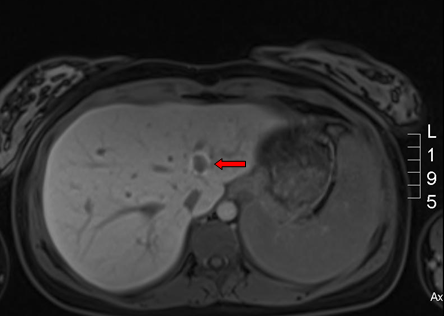
A healthy baby girl was delivered via spontaneous vaginal delivery at term. Within a few days postpartum, an abdominal computed tomography scan revealed a large left heterogeneous mass with mixed density and contrast enhancement and a small indeterminate liver lesion (Figures 1 A and B). Open left radical nephrectomy was performed 3 weeks following delivery. Intra-operatively, there was no evidence of metastatic disease and a 2086g left renal tumor measuring 23.0x17.0x13.0 cm3 was successfully removed. The post-operative recovery was uneventful. Pathological analysis revealed chromophobe RCC, pT2bN0M0 with peri-nuclear halo and transitional cells (Figure 1 C). There was no venous infiltration and the tumor was CK7, CD117 positive and CD10 negative with no sarcomatoid or rhabdoid differentiation. Surgical margins were clear. Magnetic resonance imaging at one week post-operation showed a small liver nodule consistent with focal nodular hyperplasia and no appearance of typical metastasis in the liver (Figure 2). On follow up, the patient remained well with no evidence of recurrence or metastases.
Figure 2: T1 weighted MRI (axial view): Liver lesion consistent with focal nodular hyperplasia (arrow).
DiscussionUrological tumors diagnosed during pregnancy are rare. Approximately 70 cases of RCC have been reported so far (3). Of these, the incidence of chromophobe RCC remained the lowest (4). RCC often mimics common benign pregnancy-related symptoms such as abdominal pain, urinary tract infections and urinary calculi. Therefore, similar symptomatology between an enlarging RCC and pregnancy-related conditions may delay the diagnosis and treatment of such renal tumors (5). In the literature, the most common symptoms in pregnant women with renal cancer were: palpable mass (88%), pain (50%), haematuria (47%), fever (21%), hypertension (18%) while the classical triad of symptoms was noted in only 21% 0f cases (6). In our case, the patient did notice mild abdominal discomfort which was dismissed by the patient as pregnancy-related aches.
It has been
proposed that pregnancy related hormonal changes may act as promoters
for renal
malignancy. For example, high estrogen levels during pregnancy can
promote
malignant changes by stimulating renal cell proliferation (7). However, there has been no demonstrable
immunodeficiency in pregnancy to antigens carried by tumor cells (8). Furthermore, in most cases, the biological
behavior of malignancy is not influenced by pregnancy (9).
The safest
imaging modalities in pregnancy are ultrasonography and Magnetic
Resonance
Imaging (MRI) with both of them containing minimal risk for ionizing
radiations. However, several factors may explain the delay in diagnosis
of
renal cancer in pregnancy. Most small renal masses are asymptomatic and
further
assessment is often not indicated largely because of insufficient
safety data
of radiation during pregnancy. (10).
Radiological assessment of extra pelvic organs is also not part of
routine
antenatal screen. The early pregnancy scan usually performed before 15
weeks
establishes the viability, gestational age, fetal number and gross
anomalies. The anomaly scan usually performed at 20 weeks involves
assessment of
major organs and seek out any anomalies. These recommended
antenatal
scans usually focus only on the pelvic region and fetal structures.
A full
abdominal ultrasound during pregnancy will allow the early diagnosis of
malignancies or diseases of other organs which may impact upon the
well-being
of the mother and fetus. This slight modification of full abdominal
ultrasound
is fast, simple to perform, and safe for both fetus and mother. Some authors recommend that a total abdominal
ultrasound be performed at least once in all pregnancies in addition to
routine
fetal ultrasonography, especially in the presence of loin or abdominal
pain,
hematuria or hypertension (11, 12). Once
a urological malignancy is detected on ultrasonography, the safest
modality for
further imaging studies is MRI. Radiological contrast agents should be
avoided
due to transplacental risk and teratogenic effects (13).
In our case, serial ultrasound scans were used as MRI was not
readily accessible in the regional center.
In the case of
RCC, timely diagnosis and management is crucial in predicting
maternal-fetal
prognosis. Timing of surgery for renal tumors during pregnancy is
controversial. Recommendations regarding the timing of surgery are
dictated by
time of diagnosis, size and stage of tumor, probability of malignancy,
general
health of the mother and probability of survival of the fetus.
Probability of
cure is directly related to the stage of malignancy. Surgical resection
remains
the mainstay of treatment. Most renal
neoplasms are slow growing with an average volume doubling time of more
than
500 days (4).Therefore it may be
reasonable to await fetal delivery prior to surgery if the neoplasm is
detected
during late stages of pregnancy. During diagnosis of suspicious
malignant renal
mass in the first trimester, surgery is often not delayed despite the
small
increased risk of miscarriage (14).
However, surgery during second trimester will need to
balance the
maternal and fetal risk of abortion and preterm labor with the risks of
delaying surgery. Avoidance
of disruption of the peritoneal cavity in the extra-peritoneal approach
may
theoretically be associated with less uterine irritation and in turn
fewer
obstetrics complications, including preterm labor (15).
This is especially critical in the management of small renal
cancers due to increased risk of maternal-fetal adverse outcome before
32 weeks
gestation (16).
With the
discovery of renal tumor during third trimester, delivery followed by
nephrectomy is recommended (17). It is
reasonably safe to observe small renal masses and a short delay in
definitive
treatment in the third trimester. On the other hand, for large tumors,
or
tumors which exhibit very rapid growth as occurred in this case,
nephrectomy
should not be delayed. If the diagnosis
of renal tumor is near term, nephrectomy should be postponed till
post-delivery.
However, some physicians recommend immediate nephrectomy irrespective
of the
pregnancy stage. Because, they feel that the main priority is to the
mother’s
welfare (18). Nevertheless, in the
presence of malignancy, maternal-fetal morbidity and mortality should
be
carefully considered with maternal health as the top priority (19). The patient needs to be thoroughly
informed of all possible risks versus benefits of management options
laid out
through discussions in a multi-disciplinary conference (urologists,
obstetricians and oncologists).
Conclusion
Routine complete abdominal ultrasound screening during pregnancy will benefit patients. Furthermore, a patient-centered multidisciplinary approach is
preferred to
maximize a favorable maternal-fetal outcome in the management of
suspicious
renal masses during pregnancy. Prompt diagnosis and management of RCC
during
pregnancy is important because it is potentially curable.
Conflict of interest: None.
References
1.
Smith LH, Danielsen B,
Allen ME, Cress R. Cancer associated with obstetric delivery: results
of
linkage with the California cancer registry. Am J Obstet Gynecol. 2003;189:1128-1135.
2.
Lee YY,
Roberts CL, Dobbins T, Stavrou E, Black K, Morris J, Young J. Incidence
and
outcomes of pregnancy-associated cancer in Australia, 1994-2008: a
population-based
linkage study. BJOG. 2012;119:1572-1582.
6.
Walker JL,
Knight EL. Renal cell carcinoma in pregnancy. Cancer.
1986;58:2343-2347.
8.
Donegan WL.
Cancer and pregnancy. CA Cancer J Clin. 1983;33:194-214.
12. Khochikar
MV.
Management of urological cancers during pregnancy. Nat Rev Urol.
2010;7:195-205.
14. Wilcox
AJ,
Weinberg CR, O'Connor JF, Baird DD, Schlatterer JP, Canfield RE,
Armstrong EG,
Nisula BC. Incidence of early loss of pregnancy. N Engl J Med.
1988;319:189-194.
15. Gladman
MA,
MacDonald D, Webster JJ, Cook T, Williams G. Renal cell carcinoma in
pregnancy.
J R Soc Med. 2002;95:199-201.
17. Bettez
M,
Carmel M, Temmar R, Cote AM, Sauve N, Asselah J, Sabbagh R. Fatal
fast-growing
renal cell carcinoma during pregnancy. J Obstet Gynaecol Can.
2011;33:258-2561.
18. Gnessin
E,
Dekel Y, Baniel J. Renal cell carcinoma in pregnancy. Urology.
2002;60:1111.
19. Pentheroudakis
G, Pavlidis N. Cancer and pregnancy: poena magna, not anymore. Eur J
Cancer. 2006;42:126-140.